
The central bank is yet to consider actions such as a rate hike or mobilising dollar inflows from non-resident Indians to boost forex reserves as it cannot afford to continue with them for long when the rupee's internationalisation tops its agenda, explains Tamal Bandyopadhyay.

India's exports jumped by 19.37 per cent to $38.13 billion in November, while imports dipped by 1.88 per cent to $62.66 billion, according to government data released on Monday.

Donald Trump claims the US military decimated Iran's Navy and Air Force, hinting at regime change while Iran accuses the US and Israel of planning a ground invasion.

Gold prices experienced a significant drop in futures trading due to global selloff, inflation concerns, and a strong US dollar. Analysts predict a continued downward trend amid geopolitical tensions and potential rate hikes.

India and the United States are committed to finalising an interim trade agreement, despite recent challenges including the US imposing a blanket 10 per cent surcharge and India's decision to wait for a new global tariff architecture. The US Trade Representative's annual report highlights India's maintained high import tariffs and various non-tariff barriers across several sectors.

A 500 per cent tariff would effectively shut out India's goods and services exports to the US.

An India-flagged LPG tanker, Jag Vikram, has successfully crossed the Strait of Hormuz following a temporary ceasefire between the United States and Iran, marking a significant development for India's energy security.
Delhi Police have arrested a 33-year-old man for allegedly manufacturing and storing counterfeit automobile parts and packaging materials in a godown in west Delhi.

The question is whether the clocks allow enough time for two deeply mistrustful sides to get there, and whether the surface calm holds long enough for the paddling to produce something before the ceasefire ends on April 22, notes Prem Panicker in his must read blog on the Iran War.

China has denied any links to the Iranian cargo ship seized by the US in the Gulf, which allegedly contained chemical materials for manufacturing missiles. The denial follows allegations by former US envoy to the UN Nikki Haley, who claimed the ship was headed from China to Iran.
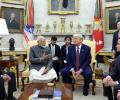
Prime Minister Narendra Modi and US President Donald Trump discussed the Middle East crisis, with a focus on the Strait of Hormuz.

'We are profoundly energy-dependent on the Gulf. That dependency must now be redirected towards the United States, because we require American permission to procure oil.' 'We additionally require Iranian permission to acquire oil from that source. So India now has to seek two separate permissions merely to secure its energy supply.' 'Should we be compelled to source from America, or from Venezuela -- which is, in effect, American-controlled supply -- that will inevitably carry a price premium, an elevated shipping cost, and a considerably extended delivery timeline, given the distances involved.'

S&P Global Ratings has increased India's GDP growth forecast for the next fiscal year to 7.1 per cent, citing private consumption, investment, and exports as key drivers. However, the agency also cautioned that the conflict in the Middle East could strain India's fiscal position due to higher energy prices.

The US blockade on Iranian ports is aimed to curb Iranian energy exports, thereby crippling its economy to force Iran back to the negotiating table, points out Commodore Venugopal Menon (retd).

Iran has blamed the US for disruptions in oil and gas shipping through the Strait of Hormuz, citing 'destabilising actions' as the cause amid the ongoing West Asia conflict and rising energy prices.

According to the report, the Pentagon is deploying the USS Tripoli ARG, along with the 31st Marine Expeditionary Unit (MEU), part of its own strike group.
India responds to US President Trump's claim that PM Modi assured him of halting Russian oil imports, stating it is diversifying energy sources to meet market conditions and safeguard consumer interests.

Former US President Donald Trump claimed that Iran has agreed to return its "nuclear dust" to the United States as part of broader assurances not to pursue nuclear weapons. He expressed optimism about ongoing negotiations and a potential deal.

Whether Trump will actually press ahead with the oil sanctions remains unclear, since keeping Russian oil out of the world market risks high oil prices which could boomerang on the US economy and be damaging politically for Trump, points out Ambassador M K Bhadrakumar.

The intriguing bit is that Trump is likely to attend the talks in Islamabad this weekend -- if he does, it will be the clearest signal yet that the US is ready to exit the war with some sort of win to show, since he cannot afford to go for the talks and return empty-handed, notes Prem Panicker in his must read blog on the Iran War

Iran has not closed the Strait. It remains open; however, due to current conditions and circumstances, ships are unable to pass through the Hormuz. Otherwise, Iran never wanted the Strait to be closed or blocked, the supreme leader's representative said.

Egypt, Pakistan, Saudi Arabia and Turkey met in Islamabad in what analysts say is the formal opening of a new diplomatic formation that could reshape the post-war regional order. Their immediate goal is a ceasefire; their larger ambition is to ensure that neither Iran nor Israel emerges from this war in a dominant position. Pakistan's foreign minister then flew directly to Beijing and mooted a Chinese role as guarantor of any eventual agreement. Prem Panicker continues his must read daily blog on the Gulf War.
India's exports to the US contracted 8.6 per cent to $6.3 billion in October, while imports rose 13.9 per cent to $4.5 billion leading to a trade surplus of $1.8 billion during the month.

When missiles fly in this region, they are never just aimed at military targets.

The US Navy seized an Iranian-flagged cargo ship in the Gulf of Oman, escalating tensions as ceasefire talks face uncertainty. The incident raises concerns about the fragile ceasefire and the ongoing blockade of the Strait of Hormuz.

The Iranian Foreign Ministry has stated that Tehran currently has no plans for a subsequent round of negotiations with the United States, according to the state media Tasnim news agency. This announcement comes as international mediators had hoped for a follow-up to the Islamabad talks before the looming ceasefire deadline.
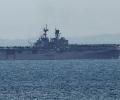
Although extensive air attacks have been carried out to destroy most of Iran's defence capabilities, the latter's resilience and sustenance during the war clearly indicate that the US landing force would encounter severe resistance in the operation, explains Commodore Venugopal Vengalil (retd).

The Reserve Bank of India (RBI) Governor Sanjay Malhotra is now confronting the classic growth-inflation tradeoff, a situation exacerbated by the West Asia war, which threatens to end the 'goldilocks period' of low inflation and robust growth.

A simple routine of cleansing, moisturising and sunscreen is more effective than piling up products, advises Dr Rupika Singh, dermatologist and founder of Akiya Aesthetics.

Amid rising tensions, Iran reportedly launched ballistic missiles toward a US-UK military base, prompting concerns about regional stability and the potential for escalating conflict in the Middle East.

The measures announced by it risk backfiring, disrupting the foreign exchange market, and intensifying the very pressures they seek to contain, with broader consequences for the economy points out Rajeswari Sengupta.

10 stocks from the Nifty 200 index that offer good growth potential and scope to deliver decent returns from current levels, based on brokerage estimates.

US President Donald Trump threatened to bomb Iran if a deal is not reached before the ceasefire ends, while Pakistan urged both sides to extend the truce and pursue diplomacy.

The United States, which entered this war in expectation of a short, sharp win along the Venezuela model, is now preparing for deeper involvement in a conflict it does not fully control, without the allies it typically relies on, against an adversary that is not behaving as expected, in a global environment that is already absorbing economic shock. Prem Panicker continues his must read daily blog on the Gulf War.

Despite outward displays of cordiality, a formal visit by King Charles III to the US revealed underlying tensions between the leaders, highlighted by subtle rebukes and contrasting views on key issues.

Amid escalating tensions with Iran, President Trump is urging nations dependent on Middle Eastern oil to deploy warships to the Strait of Hormuz to safeguard critical global energy supplies.

The conflict may disrupt Budget 2026-2027 projections, squeezing revenues and raising subsidies, prompting fiscal adjustments and potential reforms, echoing lessons from the Covid-era shock, points out A K Bhattacharya.

Both sides have now revealed a preference for escalation over strategic defeat, and each new provocation narrows the space for the next pause. The Touska seizure, Iran's refusal to negotiate under blockade, Israel's strikes on Iranian oil infrastructure -- all of these add up to an increasingly untenable situation. This makes the wild card -- Trump and his motormouth -- more consequential than ever, notes Prem Panicker in his must read blog on the Iran War.

On Saturday, it was reported that a drone strike had targeted the Fujairah Port in the UAE, triggering a fire.

Private bus operators in Sri Lanka warn of potential service disruptions and a nationwide strike due to significant fuel price increases, impacting public transport and raising concerns about inflation.
